
EU funding often looks attractive when banks say no and private investors are hard to find. For many founders in Europe, it appears to be a logical alternative: public money, large budgets, and the promise of support for innovation.
I have gone through the EU funding system myself, and I have spoken with many founders who have tried; some successfully, many not. What I noticed early on is that most guides to EU funding fall into two categories. They are either overly optimistic, making the process sound easier than it is, or so vague and bureaucratic that founders walk away more confused than before.
Founders are not looking for marketing language or press releases. They are looking for straight answers.
This article is an honest, founder-to-founder guide to EU funding. I explain what it really is, who it is designed for, and when it actually makes sense to pursue it. Not in theory, but in practice.
EU Funding for Startups: What It Is & Who Gets It in 2026
In the video below, I explain EU funding for startups, who qualifies, and how to think about it in 2026.
What EU Funding Really Is
At its core, EU funding is public money allocated by the European Union to support specific policy goals: innovation, competitiveness, employment, sustainability, and economic cohesion across member states.
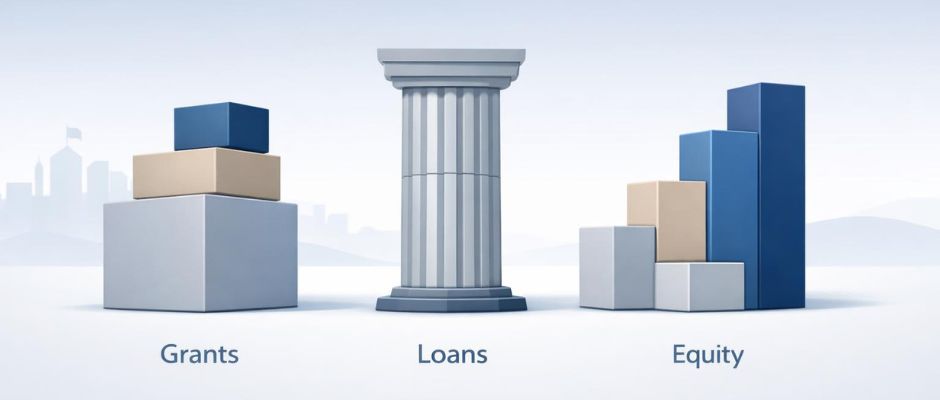
For founders, this usually takes three forms:
- Grants, which do not need to be repaid but only cover eligible project costs
- Loans, often provided through national banks with EU backing and favorable terms
- Equity investments, where EU instruments invest directly in startups in exchange for shares
Grants are the most attractive option and the one most founders focus on. But they also come with the strictest rules, the highest competition, and the greatest administrative burden.
EU funding is not designed to “save” struggling businesses or replace private capital. It exists to push the market in directions that private investors are reluctant to support on their own; such as early-stage research, deep technology, or long-term innovation with uncertain returns.
This distinction matters. Many founders approach EU funding as a financial solution. In reality, it is a policy instrument.
The Main EU Funding Programs Founders Encounter
There are many EU programs, but only a few are truly relevant to founders and startups.
Horizon Europe and the European Innovation Council (EIC)
Horizon Europe is the EU’s flagship research and innovation program. Within it, the European Innovation Council (EIC) is the most relevant instrument for startups.
- EIC Pathfinder supports very early-stage, high-risk research and breakthrough ideas
- EIC Transition helps move technologies from research into early commercialization
- EIC Accelerator targets startups ready to scale, offering grants (up to €2.5M) and optional equity investments (up to €15M)
These programs focus heavily on deep tech areas such as AI, biotech, energy, advanced materials, and hardware. They are not designed for typical software-as-a-service startups, marketplaces, or service businesses unless there is a strong technological innovation component.
EU-Backed Loans and Financial Instruments
In addition to grants, the EU supports businesses through loan and guarantee schemes delivered via national banks and financial institutions. These are now largely coordinated under broader frameworks such as InvestEU and the Single Market Programme.
These instruments are more relevant for established SMEs seeking financing for expansion, equipment, or working capital, rather than early-stage startups.
The important point is this: EU funding is fragmented by design, and the rules change depending on the instrument, the country, and the policy goal.
Why the EU Funds Businesses at All
Europe has a different economic structure than the United States or China. Private investment is generally more cautious, markets are more fragmented, and scaling across borders is harder.
EU funding exists to compensate for these structural weaknesses. It is meant to:
- encourage risk-taking where private capital hesitates
- promote cross-border collaboration
- reduce economic gaps between regions
- steer innovation toward strategic priorities such as climate, health, and digitalization
This explains both the opportunity and the frustration founders experience. The EU is not optimizing for speed or founder convenience. It is optimizing for accountability, fairness, and policy impact.
If your project does not clearly align with EU priorities, no amount of effort will make it fundable.
Who EU Funding Is Actually For
EU funding is not open to everyone, and this is where many founders misjudge their chances.
At a basic level, applicants must usually be based in an EU member state or an associated country. Most programs target small and medium-sized enterprises (SMEs), defined as having fewer than 250 employees and turnover below €50 million.
But formal eligibility is only the first filter.
In practice, EU funding favors businesses that meet several deeper criteria:
- A high level of innovation, often technological
- A clear alignment with EU policy goals
- The potential for wide economic or societal impact
- A capable team with the ability to execute and report
For programs like EIC Accelerator, the bar is particularly high. Incremental improvements, standard digital products, or local service businesses rarely succeed.
Many founders assume that being “European” is enough. It is not.
I have seen solid businesses rejected simply because they lacked a strong innovation angle. Consulting firms, marketing agencies, and conventional e-commerce models almost always struggle unless they are embedded in a broader R&D effort.
This is not a judgment on business quality. It is a reflection of what the EU is trying to fund.
A Simple Self-Assessment Before You Apply
Before investing serious time, founders should ask themselves a few honest questions:
- Is my business driven by innovation or by execution?
- Does my project contribute to EU priorities such as sustainability, digital transformation, or competitiveness?
- Can I commit months to an uncertain application process?
- Am I prepared for strict reporting and limited flexibility after approval?
If the answer to several of these is no, EU funding is probably not the right tool, at least not yet.
What the Application Process Is Really Like
Applying for EU funding is a long and demanding process. It typically begins with identifying the right call on the EU Funding & Tenders Portal.
For programs like EIC Accelerator, the process is staged. It often starts with a short proposal, pitch deck, and video. If shortlisted, applicants are invited to submit a full proposal.
The full application is detailed and technical. Founders must explain:
- the problem and innovation
- the market and competition
- the implementation plan
- the team and governance
- the budget and expected impact
Evaluation is done by external experts, who score proposals on criteria such as excellence, impact, and implementation. In some programs, finalists are invited to pitch to a jury.
From submission to final decision, timelines of three to six months are common. Success rates are typically low, often between 5% and 15%, depending on the program.
This means that even strong applications fail. I was rejected more than once before securing funding, and the feedback -when provided- is often brief and generic.

The Hidden Cost: Time and Focus
The biggest cost of EU funding is not money. It is time.
Preparing a serious proposal can easily take hundreds of hours. For early-stage founders, this often comes at the expense of customer development, product iteration, and sales.
After funding, the administrative burden continues. Reporting requirements, financial audits, and compliance checks are part of the deal. Deviating from the approved plan usually requires formal approval, which limits agility.
Some founders later regret winning funding because of how constrained they feel. This does not mean EU funding is bad; it means it is not designed for speed.
The Real Benefits and the Trade-Offs
EU funding can be extremely valuable in the right context.
The benefits include:
- Non-dilutive capital, especially valuable at early stages
- Credibility, which can help attract partners and investors
- Access to networks, research institutions, and collaborators
In sectors like biotech, cleantech, or hardware, EU funding often enables projects that would otherwise be impossible.
But the trade-offs are real:
- long timelines
- heavy administration
- limited flexibility
- delayed payments tied to milestones
EU funding rewards discipline and patience, not rapid experimentation.
When EU Funding Makes Sense
EU funding tends to make sense when:
- your business is R&D-heavy
- your innovation aligns with EU priorities
- you can afford long application cycles
- you have alternative funding or a financial buffer
It is particularly suitable for deep tech startups validating technology before commercialization.
It makes less sense when:
- you need fast capital
- your business model is execution-driven
- flexibility and speed are critical
- your innovation is incremental or local
One mistake I see often is founders applying out of financial desperation. This almost always leads to rushed applications and rejection.
EU funding should be treated as one strategic option among many, not as a lifeline.
Common Myths About EU Funding
Several myths continue to mislead founders:
- “It’s easy money.” It isn’t. Competition is fierce.
- “Any startup can apply.” Most cannot, in practice.
- “There are no strings attached.” Reporting and audits are extensive.
- “It’s faster than raising capital.” Often the opposite.
These myths persist because of marketing by consultants and selective success stories. The reality is more nuanced.
Alternatives Worth Considering
EU funding is not the only option.
Depending on your country, national programs may offer grants or loans with simpler procedures. Many EU funds are ultimately distributed at the national or regional level with adapted rules.
Venture capital and angel investors remain faster and more flexible, though they require giving up equity.
Bootstrapping, crowdfunding, R&D tax credits, and accelerator programs can also be effective, depending on your situation.
Each option has trade-offs. The key is to choose based on speed, control, and strategic fit; not ideology.
A Final Reflection
EU funding reflects Europe itself: careful, rule-driven, and focused on long-term goals rather than short-term speed.
For the right type of founder and project, it can be a powerful enabler. For others, it becomes a distraction.
The most important skill for founders in Europe is not learning how to apply for EU funding. It is learning when not to.
Understand the system, decide honestly where you fit, and choose your path accordingly. That clarity alone will save you months -if not years- of wasted effort.